
I have written about 25 facts regarding sloths from the book National Geographic Kids, 5,000 Awesome Facts that I happened to acquire from a free library while on my walk with Charley Waffle. (charleywaffle.com) I found it to be very interesting and I wanted to see if the facts still stand today, plus I wanted to learn more about each fact.
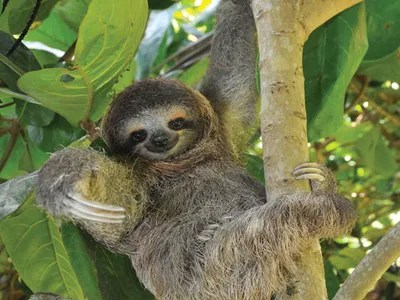
In conclusion sloths have become one of my favorite animals. There are two-toed sloths, along with three-toed sloths. They come in the same family as anteaters and armadillos.
It’s true they don’t move that fast, but it is a means of survival so other predators can not see them and attack them. As a matter of fact the only real scary time they face predators is when they are doing their once a week potty trip to the base of the tree, or from Harpy eagles up above if they are on the top of a tree.
They do not attack anything except leaves on a tree, which a leaf takes a month to digest due to their 4 portal stomachs.
(Watch How to Survive a Sloth Attack on YouTube)
Sloths do not do well in captivity, nor do they do well being hugged and handled by humans. It is known that their heart rate rises when being touched, making it stressful for them. Those cute photos of sloths being held by humans don’t make them feel that cute, regardless of them looking as if they are smiling. They should be admired afar and photographed that way as well.
They are somewhat endangered due to deforestation where they live in South and Central America. They survive in peace in the trees of the forest.
They have been around for thousands of years, at a point where they where as big as elephants and as tall as a giraffe. They even swam back then as they do now. Actually, they are considered excellent swimmers.
Their fur is a micro diversity of algae, and there is only one particular moth that is found on sloths in the world. ”Some species of fungi living in sloth fur have been found to be active against certain strains of bacteria, cancer and parasites.” -www.slothopedia.com
Please visit slothconservation.org on how to donate to save a sloth or to plant a tree for these amazing creatures.
other info came from:
Wikipedia.org/sloth, http://www.britacannica.com
 CHARLEY WAFFLE