
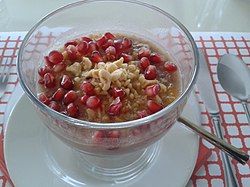
“Dating back thousands of years, ASHURA, a sweet Turkish pudding made with fruits, grains, and nuts, is considered the oldest dessert in the world.”
National Geographic 5,000 Awesome Facts, fact # 2 of 35 in Decadent Incredible Desserts
According to https://www.dailysabah.com/feature/2014/11/03/the-oldest-dessert-in-the-world-ashura, ashura is a “delicious pudding with everything in it.”
It is also called Noah’s pudding and came out of Turkey, and is known as the oldest dessert in the world. In one Turkish legend it says that supplies started dwindling on the arc, so Noah threw all the bits and pieces of what was left over into a kettle and made the concoction now called ashure.
In another legend the pudding was made after Noah and his family disembarked the arc in celebration of surviving the flood. (https://www.umass.edu/gso/rumi/ashura.pdf) It is a symbol of “health, happiness, peace, wealth and success”, given out in abundance to family and friends.
Some ingredients include whole grain wheat or barley, apricots, figs, currants, pine nuts, navy beans and chickpeas, raisins, hazelnuts and walnuts, to name a few. However, there are a hundred different ingredients that can be used determined by the cook. The original recipe called for rose water but can be substituted with orange or lemon peel.
Here is just one recipe for the pudding per http://www.umass.edu;
- Cup of wheat
- Cup of white beans
- Cup of garbanzo beans
- Cup of raisins
- Cup of almonds
- 3/4 cup peanuts
- 12 dried apricots
- *5 1/2 cups of sugar*
- Water (enough to cover)
Soak wheat, white beans, garbanzo beans and almonds in water overnight, boil the ingredients, take off shell or skin.
- Soak the raisins until softened
- Put all ingredients in a large pot and boil
- Cut apricots into small pieces, add to mixture along with sugar
- Boil 10-15 minutes
Pomegranate seeds and orange peel is recommended.
*Molasses, fruit juices and honey was used to sweeten the pudding as well.*
“Armenians make it as a Christmas pudding and for New Year’s celebrations, where it is a centerpiece,[1] and in the Balkans and Turkey, Sufi Muslims make the dish during the month of Muharram in which the Day of Ashure takes place.[2] Sephardic Jews prepare the dish to celebrate the Jewish holiday of Tu BiShvat.[3][4] In some Jewish, Christian, and Muslim traditions, a similar dish is prepared to commemorate a child’s first tooth, or the passing of a family member.” (https://en.wikipedia.org/wiki/Ashure)
 CHARLEY WAFFLE
Leave a comment