
In my old apartment I noticed these red bumps on my forearms. I disregarded them thinking it was an allergic reaction to new body lotion I had bought. I stopped using it and waited for the skin to clear. However, once I stopped using it I noticed I was still getting these red bumps on my arms. I thought maybe it was my laundry detergent, but that was weird because it had never bothered me before.
Then, I happened to see a bug that looked like a beetle on my bed, so I jumped up and pulled off the fitted sheet, discovering a few of these bugs huddled in the creases. I was horrified. Absolutely horrified.
These were bed bugs. I heard some people in the complex had them, leading to a sniffing dog checking homes. My house was fine before, and I had never seen a bed bug. But now they were in my bed. After finding them, I noticed some signs: rust-colored spots on my blankets and the wall. I then realized they were everywhere.
I quickly stripped my bedding and put it in the hot washing machine, then did the same with my clothes. I vacuumed and mopped the floor, thoroughly cleaning my house.
I’ve heard they are sneaky and tough to get rid of, so I decided to investigate further and take action.
This is what I found:
What is a bed bug?
Bed bugs are from the group of cimicidae; in which all insect members feed exclusively on blood. They originally were cave dwelling bugs that fed on the blood of bats but ever since humans started living in caves the bugs started feeding on humans. Once moving out of the caves the bugs moved on to agricultural civilizations following the humans.
The adults are brownish/reddish and are flat with no wings, and about 4-5 mm. They can be seen with the naked eye. Newly hatched nymphs, however, are clear in color until they feed, and are about the size of a pin head. Therefore, they can be difficult to see.
There are 5 developmental stages, a nymph, or instar, in where they shed their exoskeletons and move on to the next stage. They must feed in between growth to survive. After the 5 stages they finally reach adulthood. The total development process from an egg to an adult can take place in about 37 days if the temperature is at an optimal 72 degrees. A female lays about 1-7 eggs a day for every 10 days after a blood meal. Life span of a bed bug is about one year but depends on feeding and favorable temp. https://www.epa.gov
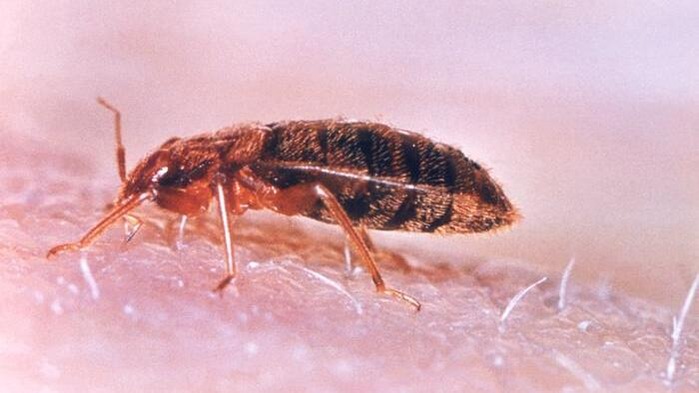
Feeding Behavior
Bed bugs lead a cryptic lifestyle in where they spend the majority of their time hiding together in cracks and crevices so they won’t be disturbed.
Due to their nighttime habits, they are active at night, drawn to CO2 and body heat from sleeping hosts. They do not live on dog fur but can move to other spots if they cling to a dog. This usually happens if the dog visits an infested area and brings one home. https://snoozerpetproducts.com
Where to find them
They can be found in North and South America, to Africa, Asia, and Europe. Bed bugs are in five-star hotels and resorts. They are everywhere.
Once a bedbug finds its way back to your house they will gravitate towards their host’s bed. They will be on the mattress, or box spring, in the bed frame, your pillow case. Because they are so small, the size of Lincoln’s head on a penny, and flat they can squeeze into any small opening. They also like cardboard, newspapers, in the seams of luggage, folded clothes, in furniture… any crack or crevice.
Other places include buses, classroom chairs, or being somewhere that someone else has visited that has bed bugs and don’t know it.
They can travel 100 feet but usually stay within 8 feet of the bed. https://www.cdc.gov/bed-bugs/about/index.html
They may take over the dog’s bed if it’s near the host’s bed. They like humans more, but will feed on a dog if nothing else is available and they need to feed.
Feeding
Bedbugs, once they find a host, they use their mouth parts to find a capillary spot where the blood flows rapidly into their body. They might probe the skin several times before feeding.
They usually feed for 5-10 minutes until full and will leave and crawl back to where they hide.
They will feed every 3-7 days. They can live for 20 – 400 days without feeding, depending on the temperature and environment. The ideal temperature is anything from 70 degrees – 80, and with humidity between 70 % or 80%. https://www.nativepestmanagement.com
Reproduction
Bedbugs have a very unique way of mating. Instead of inserting male organ into the female they stab it through the body wall in a specialized organ that is called Organ of Berlese. It’s called traumatic insemination.
Over several hours it migrates to the female’s ovaries and fertilizes the eggs.
Traumatic insemination scars the female’s body and requires time to heal, leading her to leave the aggregation to prevent further abuse.
They can lay 1 to 7 eggs daily, totaling around 500 eggs in their lifetime with regular feedings. They must feed in between to reproduce. More meals equals more eggs.
They can lay them in groups or they can drop an egg anywhere. About 97% of the eggs hatch, and have a 50/50 ratio of male and female. The eggs are tiny and usually a pearly white color. They usually hatch every 9 days, therefore doubling their population every 16 days. https://www.orkin.com
Signs of having bed bugs
There are a couple signs to look for to see if you have bed bugs.
- Red bumps on exposed skin, especially arms but can also occur on feet and legs, and even armpits. The bumps might be a single welt or can be linear signaling they couldn’t find a place to feed.
- Rust colors/blood on bedding, sheets and pillows and bug droppings.
- Bed bug casings, or their exoskeleton can be found due to the growth of the bed bug from nymph to adult. https://www.orkin.com
- A distinct, unpleasant musky odor can be smelled in heavy infestations.
Prevention and Expulsion
First of all make sure they are bed bugs and not another type of insect.
There are non-chemical ways to get rid of them;
- Heat treatment. This can be done by putting all bedding and clothes into the dryer and putting it on high heat for 45-50 minutes. That may not get rid of the whole infestation however. Professional companies have a way to heat the entire house which has a better outcome.
- Cold treatment. This may work but the freezer has to be put at 0 degrees F. You have to leave the infested items in a bag in the freezer for 3 days.
- Steam cleaners, wet or dry. They are effective in getting into cracks and fabric and other things such as the carpet, bed posts, and other furniture. The setting has to be at 130 degrees but use with a diffuser because air flow may cause the bugs to scatter.
- Pesticides. Look for EPA registered products that actually say bed bugs on it. If you want to use a fogger make sure it is for bed bugs, and follow instructions. However, foggers don’t reach into the cracks and crevices where bed bugs hide.
- Dessictants can be used, which are products that dry the bug out. Diatomaceous earth can be used, but do not use pool or food grade. There is one that is specifically used for bugs that is safer. Diatomaceous earth is made up of fossil remains from sea creatures called diatoms and can be harmful to your lungs if breathed in.
After an initial clean up, a follow up should occur in case you’ve missed any eggs.
Whenever traveling or staying in a hotel always check your luggage inside and out, especially in the seams.
Bag up anything you’ve cleaned to prevent bugs from contaminating it again. Check the areas every week for any signs of bugs.
If the infestation is really bad, it is probably better to call a pest control place.
Are they harmful?
Bedbugs can affect anyone. Having them doesn’t mean a person or their home is dirty, but less clutter can make them easier to find.
Bedbug bites often appear as hives, sometimes in a line. While they don’t spread diseases, they can cause allergic reactions in some people, resulting in blisters and severe itching. Scratching may lead to skin infections.
Having bedbugs can cause stress and sleepless nights because you know they are in your home and bed, and they can also be expensive to get rid of.
The whole thing is gross.
When I moved to my new place, I was worried about bringing pests with me. I dried all my clothes in the hot dryer and checked my luggage and boxes. I did everything I could.
I still brought one or two with me. They popped up about 3 weeks after I settled in. I freaked out. I didn’t want to go through with it all again.
I once again washed every item I own, looked through boxes, etc… Bought some diatomaceous earth that I sprinkled around. It’s called Crawling Insect Killer by Harris. I got it off of Amazon.
So far it seems to be working. I’ve not seen another one in a couple of weeks, but I will remain vigilant. They are nasty boogers.
 CHARLEY WAFFLE
Leave a comment