
“The Great Wall of China is the MOST VISITED ancient ruin, with about ten million visitors per year.” – National Geographic, 5,000 Awesome Facts
The Great Wall of China can have over 100,000 visitors a day, totaling around 20 million each year due to the wall’s length and various entry points along the way. The best times to visit is April-May, and September – October for fewer crowds and beautiful spring/fall settings. https://www.chinahighlights.com/greatwall/best-time-to-visit.htm
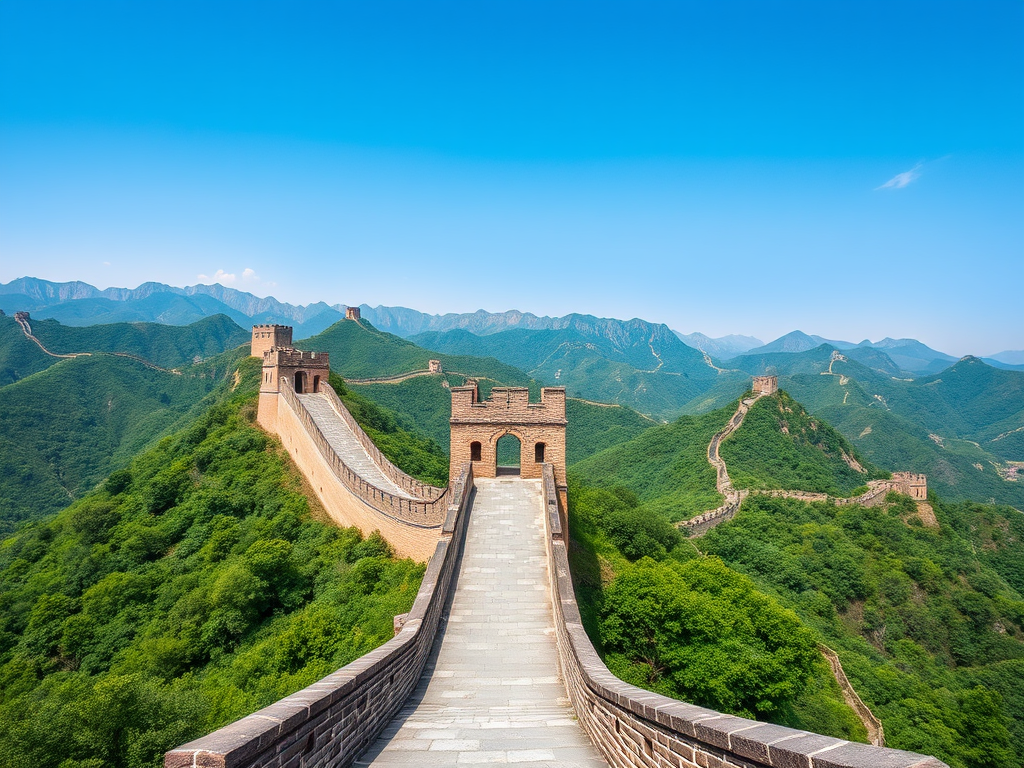
When Was the Wall Built
The Great Wall was built over 2,000 years ago, starting around 770 B.C.E. Major construction began in 220 B.C.E. under China’s first Emperor, Qin Shi Huang. The Qin Dynasty unified China by conquering warring states. The dynasty only lasted 15 years but introduced important systems like weights, measures, currency, writing, and infrastructure, including the Great Wall. This set the stage for future dynasties. https://en.wikipedia.org/wiki/Qin_dynasty
However, the majority of the wall, 5,500 miles, was built between 1368 and 1644, during the Ming dynasty.
Why Was the Wall Built
- Primarily built as a defensive fortification to protect Chinese empires from invasions and raids by nomadic groups, such as the Xiongnu and the Mongols, and to protect their agriculture.
- Border Control – it controlled immigration and migration, regulated trade and monitor movement on the northern areas.
- Military and logistics – The wall incorporated watchtowers and beacon systems to quickly relay warnings of approaching enemies across vast distances. Smoke during the day, while fire lit the night to warn of invaders.
- Strategic transport route – the top part of the wall was designed for a strategic route for the soldiers; it allowed for rapid troop deployment.
- Symbol of Power
What is the Wall Made Of?
The Great Wall of China is not just one wall; it consists of various fortifications, towers, stations, and barriers. During the Ming Dynasty, around 25,000 watchtowers were built using stones, bricks, and compressed earth. A special mortar made from sticky rice flour and lime held it together, along with wood and rubble. Some parts of the wall use natural land forms, and in the mountains, stones are taken from the ground.
The most popular part of the wall, Badaling, is 5,500 miles long. If all sections built were measured, they would total about 13,170 miles.
How Large is The Great Wall?
Emperor Qin mandated that the wall be 6 horses wide at the top, eight horses wide at the bottom, and 5 men tall. He made available hundreds of thousand of men to build the wall. For that, the Wall has gotten the nickname of “The Longest Cemetery on Earth.” Thousands, if not a million, of soldiers, peasants, and prisoners died from exhaustion, accidents, or/and exposure; many rumored to have been entombed within the wall while working on it. However, no bones have been found around the wall. https://www.history.com/articles/great-wall-of-china
And, It is the longest building ever made by humans.
However, the Great Wall of China CAN NOT be seen from the naked eye in space. That is a myth. Special lenses on a camera can help an astronaut, but another factor is that the wall blends into the terrain, making it hard to see.
Now there is roughly one third of the wall has crumbled, or deteriorated. The wall has been victim to tourists wanting to take a piece of the wall as a souvenir. It is illegal to take any part of the wall home.
Restoring The Great Wall
In 1987, UNESCO declared the Wall to be a World Heritage Site, and in 2002 it was listed as one of the world’s most endangered sites by the World Monument fund, based out of New York.
In 2003, the Chinese government began passing laws to protect the Great Wall. In 2006, the government set up the “Great Wall Protection Ordinance”, and in 2007 it was listed as one of the New Seven Wonders of the World. https://www.re-thinkingthefuture.com/architectural-styles/a8066-timeline-of-restoration-the-great-wall-of-china/
Restoration includes;
- Technological Monitoring – companies are creating high precision 3D models for virtual preservation and study. AI and LIDAR, laser, imaging, detection and ranging, are used to to help analyze the structure and identify threats.
- Manual Restoration – Traditional hand repair methods are used with material matching the original construction.
- Use of patrol teams – local teams along with villagers with great historical ties, patrol remote areas of the wall to monitor, control and clean and report issues.
( https://en.wikipedia.org/wiki/Lidar )
Education about the Great Wall helps protect it for the future. Public awareness campaigns encourage respect for this historical site, aiding in its maintenance.
 CHARLEY WAFFLE
Leave a comment